The Cost of the Missing Intent Layer · v1
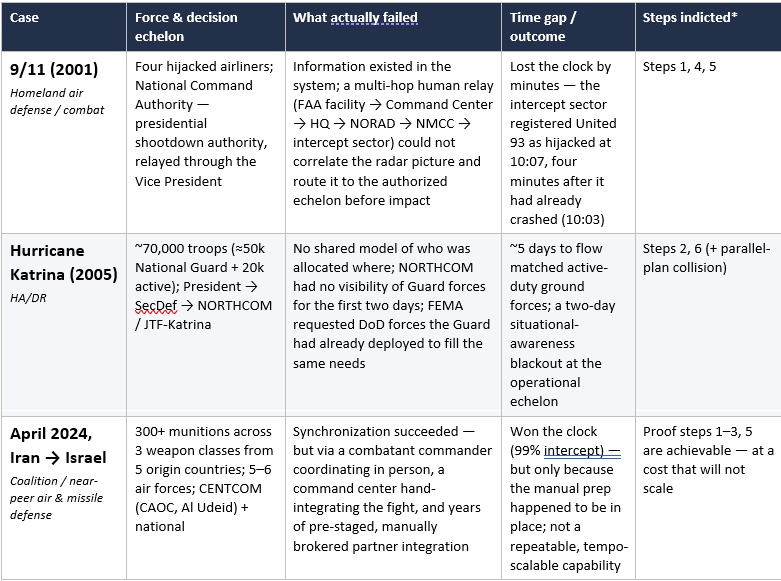
Purpose. Backing evidence for the stakes claim: when a plan breaks, the failure is rarely that no one could have known. It is that nothing assembled the available indicators into the recognition that a decision was required, bound that recognition to the relevant intent, and routed it to the echelon authorized to act — in time. Three documented cases, across combat, disaster response, and coalition defense, and three decision echelons.
Framing note (the discipline that governs this annex). These are correlation-and-routing failures, not detection failures. In every case the information existed somewhere in the system; the gap was the interval between “the data exists” and “the authorized echelon acts on it.” Framed as a detection or sensor problem, it invites the “buy more ISR” objection; framed as an architecture problem, it points only at the missing intent layer.
Deployment — pick the framing per venue
● Publication / stakes section: run the matrix top-to-bottom — minutes lost → days lost → won, but unrepeatably. A clean escalation into the thesis.
● Partner backup: invert — lead with April 2024 (the capability is real and valued at the combatant-command echelon), then use 9/11 and Katrina to show the cost of not having it.
● Sources: footnoted below for due diligence and endnote conversion. Strip the [n] markers and the References block for a clean typesetting copy.
Evidence matrix